A water heater lasts 8-12 years in Salem. A tankless lasts 15-20. That's the headline difference — but the full comparison is more interesting, especially for Pacific Northwest homes where cold groundwater and Oregon's rebate landscape change the math.
The core trade-off
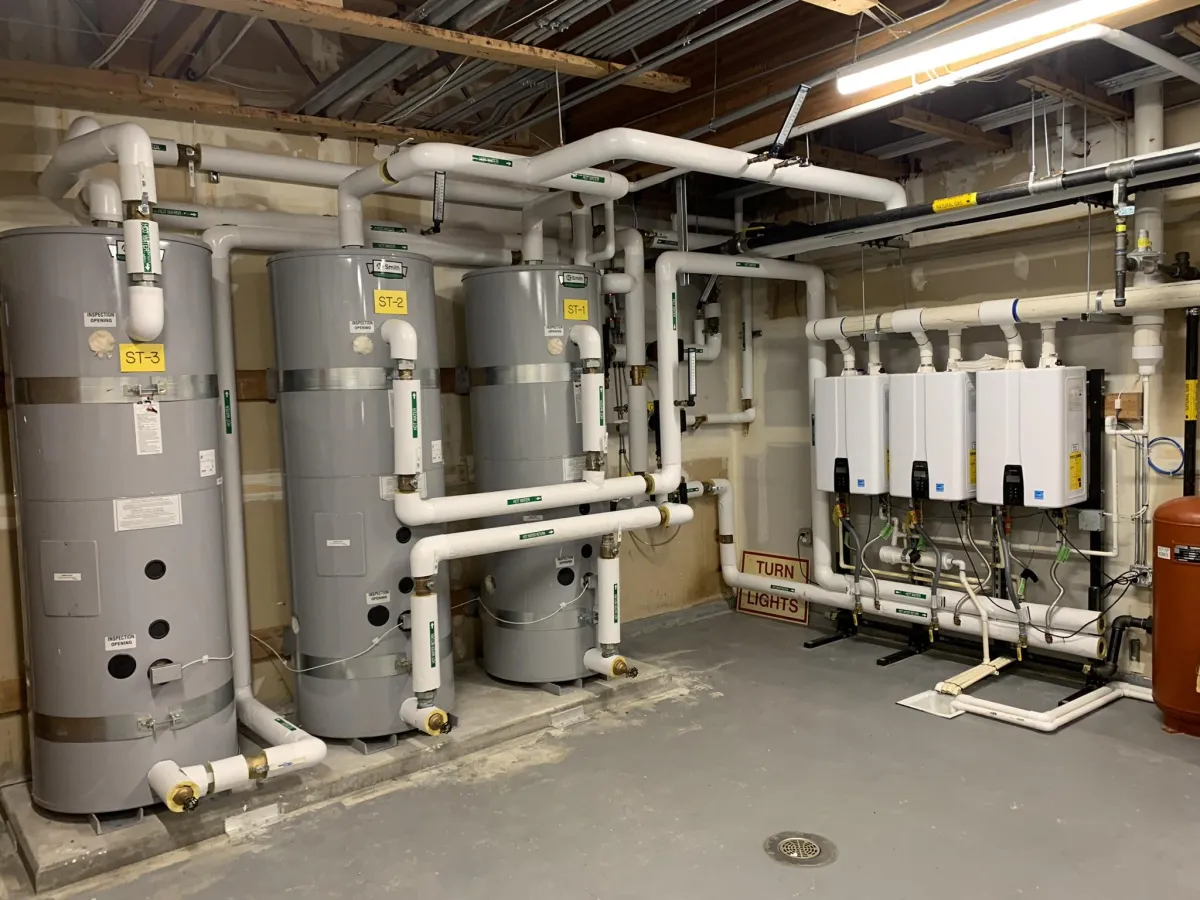
Tank water heaters store 40-80 gallons of hot water continuously, ready to use. When the water is gone, you wait for the tank to refill and heat back up (20-60 minutes depending on size and fuel type).
Tankless water heaters heat water on demand. When you open a hot tap, the unit fires and produces hot water continuously for as long as you need it. No tank, no standby loss, no running out.
Both accomplish the same basic goal — hot water when you want it. The differences are in cost, efficiency, life expectancy, and the edge cases.
The Pacific Northwest angle: groundwater temperature matters
Tankless sizing is determined by temperature rise — how much the unit needs to heat cold incoming water to reach your desired output temperature.
In Arizona, incoming groundwater is often 65-70°F. A tankless unit there raising water to a comfortable 105°F shower temperature only needs 40°F of rise.
In Salem, our groundwater runs 45-55°F year-round — colder in winter. Our tankless unit needs to raise water 55-65°F to hit the same 110°F at your shower. That requires a larger BTU unit than the same household would need in a warmer climate.
This is why tankless installations done by plumbers using national averages often disappoint Oregon homeowners. A properly-sized Salem tankless needs to handle the cold groundwater reality. An undersized unit struggles the moment a second hot fixture runs — you're in a shower, someone starts the dishwasher, and your water goes lukewarm.
Life expectancy: 15-20 years vs. 8-12 years
Tanks fail because the tank itself fails. The steel tank with glass lining has a finite service life. Once the glass lining cracks and the steel starts corroding, you're on the countdown. Average Salem tank life is about 10 years.
Tankless has no tank to fail. The heat exchanger is the expensive internal component; it can be cleaned (annual descaling) and, in many cases, replaced individually rather than replacing the whole unit. Well-maintained tankless routinely runs 15-20 years.
The catch: tankless needs maintenance. Annual descaling, especially in Salem's moderately-hard water, is essential. A neglected tankless can fail at 7-10 years — same range as a well-maintained tank.
Energy costs
Department of Energy figures: tankless uses 24-34% less energy than tank for typical household usage. Savings come from:
- No standby heat loss (tanks continuously lose heat to the surrounding air; tankless doesn't)
- Higher burner efficiency on modern tankless models
- Only heating water you actually use
For a Salem household with $400/year in water heating costs, that's $100-135/year saved. Over 20 years, that's $2,000-2,700 in energy alone.
Upfront cost
Installed prices in Salem in 2026:
- Standard gas tank (40-50 gal): $1,400-$2,200
- Tankless gas: $3,800-$6,500
- Heat pump hybrid: $2,800-$4,500 (before rebates often $500-$800)
Tankless is 1.5-2x the upfront cost of a comparable tank. Over 20 years accounting for longer life and energy savings, tankless typically comes out ahead. Over 10 years or less, the tank often wins financially.
Endless hot water — how often does it matter?
For households with 3+ people showering in sequence, running the dishwasher while one person showers, or filling bathtubs regularly, "endless hot water" is genuinely valuable. You never run out. Kids stop fighting over shower order.
For empty-nesters or single-person households, the value is smaller. A single person isn't hitting the limits of a 40-gallon tank in normal usage.
The honest recommendation
Go tankless if:
- You have or plan 3+ simultaneous hot water users
- You plan to stay in the home 10+ years
- You're willing to do annual descaling (or pay for it)
- Your home has adequate gas service (or the budget for a line upgrade)
- You qualify for Energy Trust rebates
Stay with a quality tank if:
- You're in the home under 5 years
- You prefer lower upfront cost
- Your household's hot water usage is light
- Your home needs significant upgrades for tankless compatibility and the added cost tips the math
Consider heat pump hybrid if:
- You have adequate space (needs air volume to work)
- You qualify for Energy Trust rebates that make the math attractive
- You want the efficiency of tankless without the gas line complexity
The Salem-specific take
For most Salem homeowners planning to stay 10+ years in a home with reasonable gas service, tankless comes out ahead — on life, efficiency, and the rebate-adjusted cost. For shorter horizons or homes requiring expensive upgrades for tankless compatibility, a quality mid-range tank is the right value choice.
Want a real recommendation for your specific home? Call us at (503) 917-3259. We look at your current setup, your usage, your budget, and your time horizon — then give you a straight answer, not a sales pitch.
See our water heater and tankless service pages for more detail.