Low water pressure throughout your whole house — every fixture, hot and cold, every time — has a small number of common causes. Working through them in order of likelihood is the fastest path to fixing it.
Here's how we think through it on a service call.
Step 1: Confirm it's a whole-house issue
First, confirm the problem is actually whole-house, not a bunch of individual fixture issues. Test:
- Turn on the kitchen sink cold water. Weak?
- Turn on a bathroom shower. Weak?
- Outside hose bib. Weak?
If all of them are weak, it's whole-house — read on. If only some, the problem is at those specific fixtures (usually aerator or valve issues).
Step 2: Test your static water pressure
Any hardware store sells a water pressure gauge ($10–$15) that screws onto an outdoor hose bib. Take the reading with no water running anywhere in the house.
- Below 40 psi: Low pressure confirmed at the meter. Cause is likely on the municipal side or in your supply line.
- 40–60 psi: Normal. If fixtures feel weak, the problem is after the meter — somewhere in your supply piping or at the pressure regulator.
- Above 80 psi: High pressure. Oddly, this can cause weak-feeling fixtures if it's damaging internal fixture components.
The 7 causes, ranked by how often we see them
1. Pressure regulator valve (PRV) failing (most common in Salem)
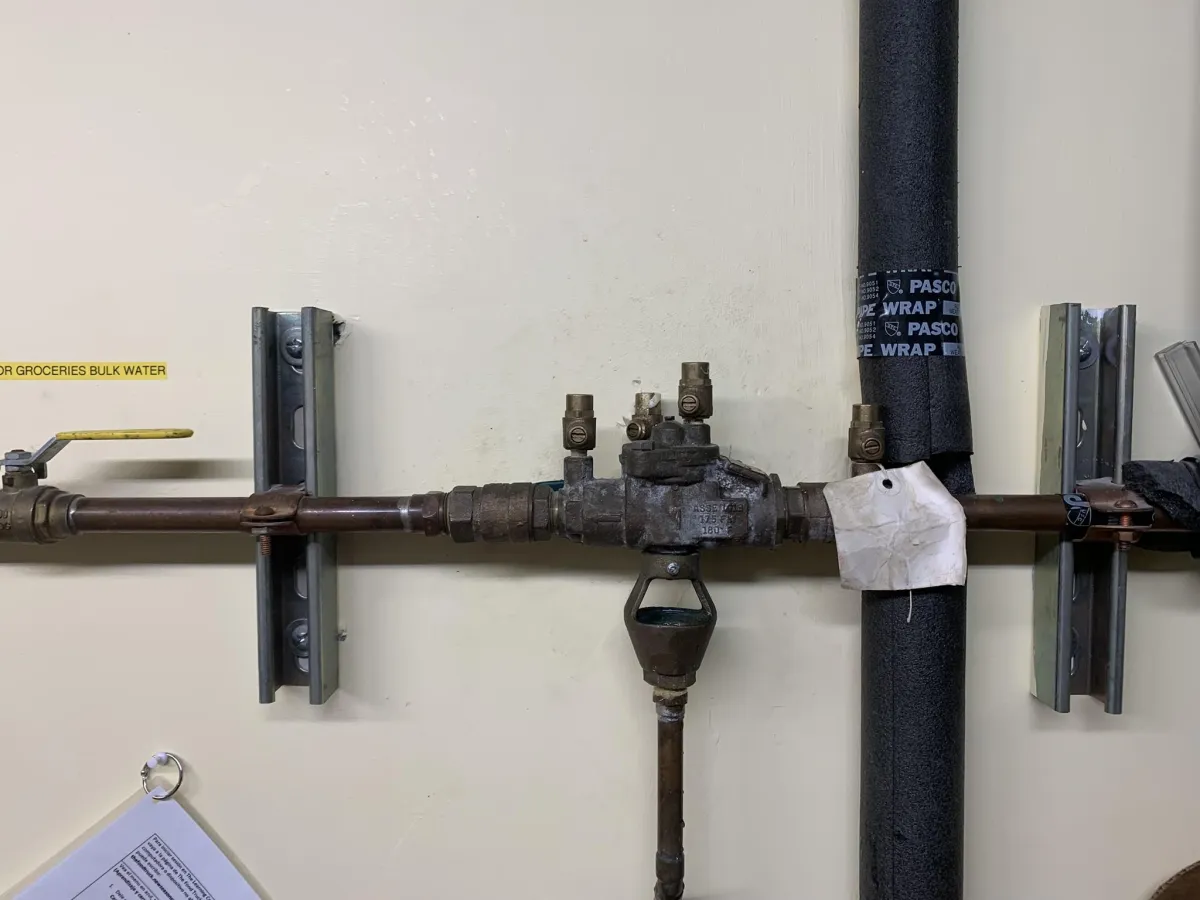
Most Salem homes have a pressure regulator valve that steps down the high pressure from the city main to a safe household pressure. These regulators wear out and fail — typically at 10–15 years of age. When they fail, they often get stuck in a position that delivers low pressure to the whole house.
How to tell: Pressure is low at the meter (outdoor spigot reading below 40 psi) but water company says pressure to your meter is fine. PRV is the likely cause.
Fix: PRV replacement, $250–$500 depending on installation complexity. Not a DIY job for most homeowners — requires shutting off main water and working on pressurized plumbing.
2. Main shutoff valve partially closed
Seems silly, but it happens — especially after recent work. If someone partially closed the main shutoff and didn't fully reopen it, pressure drops sitewide.
How to tell: Open the main shutoff fully — it's a lever or a round handle where the main water line enters the house (garage, utility closet, or basement). Turn ball valves parallel to the pipe; turn gate valves fully counter-clockwise (they're open when the valve is all the way up).
Fix: Free. You just reopened the valve.
3. Corroded galvanized supply lines (very common in pre-1970 Salem homes)
Older Salem homes with original galvanized steel supply lines develop internal corrosion that progressively restricts flow. This presents exactly as whole-house low pressure — static pressure at the meter looks fine, but by the time water reaches your fixtures, the restricted pipes have dropped the effective pressure dramatically.
How to tell: Home is pre-1970, has visible galvanized steel pipes in the basement or crawlspace, has rust-colored water occasionally, and pressure drops noticeably when multiple fixtures run.
Fix: Whole-house repiping in PEX or copper. Significant investment ($6,500–$14,000 typically) but solves multiple problems at once and lasts 50+ years.
4. Water municipality issue
Sometimes the issue isn't you. Salem's water utility occasionally has pressure issues in specific neighborhoods due to main work, line breaks, or pressure adjustments.
How to tell: Call the City of Salem Water (503-588-6333) and ask if there's any known issue in your area. Ask neighbors too.
Fix: Wait, or call the water utility. This is rare but worth checking before spending money diagnosing a home-side issue.
5. Hidden leak in the supply line
A significant leak in the main supply line (between the meter and the house, or inside the house) reduces the pressure available to fixtures. This category is dangerous because the leak is doing damage somewhere while you notice the pressure.
How to tell: Shut off every fixture in the house and watch the water meter. If it's still ticking, there's a leak. Also check: muddy or unusually green spots in the yard between the meter and house, unexplained water bill increases, or the sound of running water when everything's off.
Fix: Leak detection and repair. Cost varies widely depending on where the leak is — $350 for an easy repair to $2,000+ for a slab leak.
6. Failed pressure tank (well-system homes)
If you're on a well rather than municipal water (common in rural Polk and Yamhill County), your pressure is maintained by a pressure tank paired with your well pump. A failed or waterlogged pressure tank causes pressure cycling — pressure drops fast as you use water, the pump kicks on, pressure returns briefly.
How to tell: Well-system home, pressure fluctuates during use rather than staying steady. Pump cycles on and off frequently even during single-fixture use.
Fix: Pressure tank replacement, typically $400–$900 for standard residential systems.
7. Water softener issues
A clogged or malfunctioning water softener can restrict flow to the whole house. If you have one and haven't serviced it recently, check it.
How to tell: Test pressure before and after the softener. If pressure is good before it and weak after it, the softener is the bottleneck.
Fix: Clean or replace resin, service the valve, or bypass the softener temporarily. $100–$400 depending on component.
When to call us
- You've checked the easy stuff (main shutoff, aerators) and pressure is still low
- Your home is pre-1970 and you're seeing multiple plumbing issues
- You suspect a hidden leak
- You just don't want to diagnose it yourself
Call us at (503) 917-3259 or request a quote online. We diagnose pressure issues with proper testing equipment and give you a straight answer about cause and cost.